

Mateusz Hoffert, M.Sc.
Technical University of Munich
Chair of Thermodynamics (Prof. Wen)
Postal address
Boltzmannstraße 15
85748 Garching b. München
- Phone: +49 89 289 16090, 16253
- Room: 5507.EG.726
- E-mail: m.hoffert@tum.de
Research project
Molecular Simulation of Ablative Thermal Protection Material under Realistic Reentry Conditions
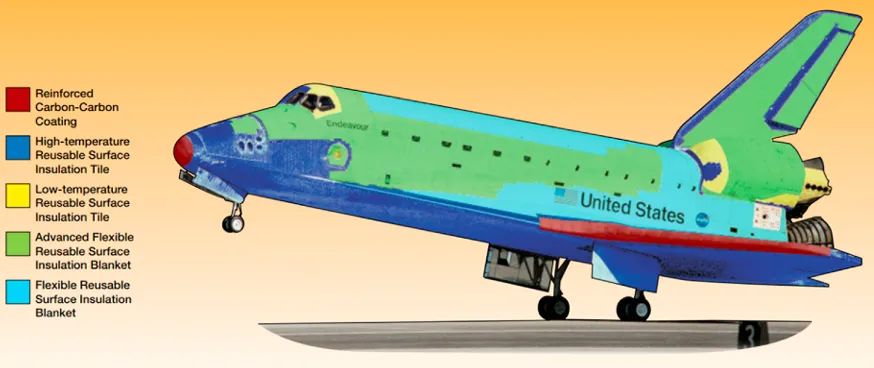
The most critical part of a successful space mission is the reentry of spacecrafts into the atmosphere. The hypersonic flow approaching the reentering vehicle undergoes a shock and converts kinetic energy into thermal energy representing an unpleasantly high thermal load on the spacecraft (Yang et al. 2021). One of the most common thermal protection strategies is to cover the exterior spacecraft housing with ablative Thermal Protection Material. In the course of reentry, heat is transferred into the material launching the process of pyrolysis and sublimation as found in the red marked regions of the Space Shuttle Orbiter in Fig 1.
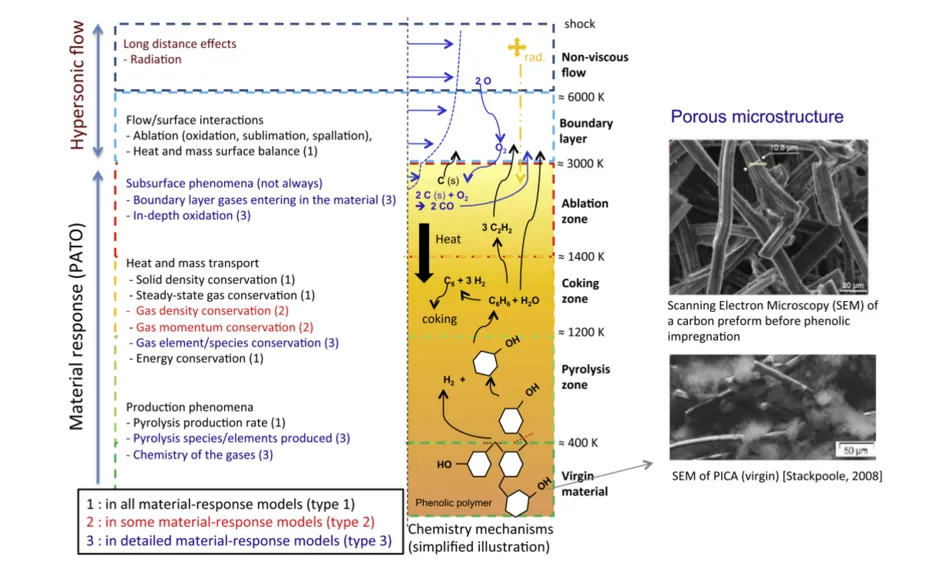
Since experimental studies are costly and reproducing real reentry conditions is difficult, the design process of a spacecraft requires accurate simulations of the material response. There have been many significant research contributions in this regard, most of which relying on single-scale continuum descriptions of the material. However, industry-relevant material response codes usually work with highly simplified models for pyrolysis kinetics and other chemical phenomena, thus necessitating a large safety margin in the design of a TPM. In order to more accurately describe ablation behavior, Molecular Dynamics (MD) simulations must therefore inform continuum material response codes.
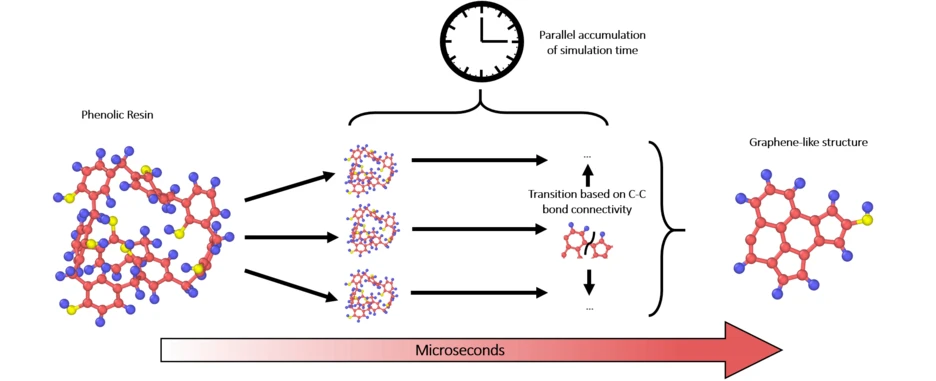
Although there exist a number of MD studies for thermal protection material, including phenolic-based materials such as the Phenolic Impregnated Carbon Ablator (PICA), these studies typically employ an unrealistically high temperature to artificially increase the reactivity of the molecular system to observe a sufficient amount of reactions within the computational limits of simulation time. The maximum simulation time is typically only a few nanoseconds. For this reason, it is my goal to establish a numerical framework to run molecular simulations for aforementioned materials at realistic temperatures and extended simulation times using Accelerated Molecular Dynamics (AMD) techniques, such as Parallel Replica Dynamics (PRD), Hyperdynamics (HD) or Kinetic Monte Carlo (KMC).
References
Uyanna, Obinna, and Hamidreza Najafi. "Thermal protection systems for space vehicles: A review on technology development, current challenges and future prospects." Acta Astronautica 176 (2020): 341-356.
Yang, Xiaofeng, et al. "Heat transfer with interface effects in high-enthalpy and high-speed flow: Modelling review and recent progress." Applied Thermal Engineering 195 (2021): 116721.
Perez, Danny, Blas P. Uberuaga, and Arthur F. Voter. "The parallel replica dynamics method–Coming of age." Computational Materials Science 100 (2015): 90-103.
Voter, Arthur F. "Hyperdynamics: Accelerated molecular dynamics of infrequent events." Physical Review Letters 78.20 (1997): 3908.
Lachaud, Jean, et al. "Detailed chemical equilibrium model for porous ablative materials." International Journal of Heat and Mass Transfer 90 (2015): 1034-1045.